
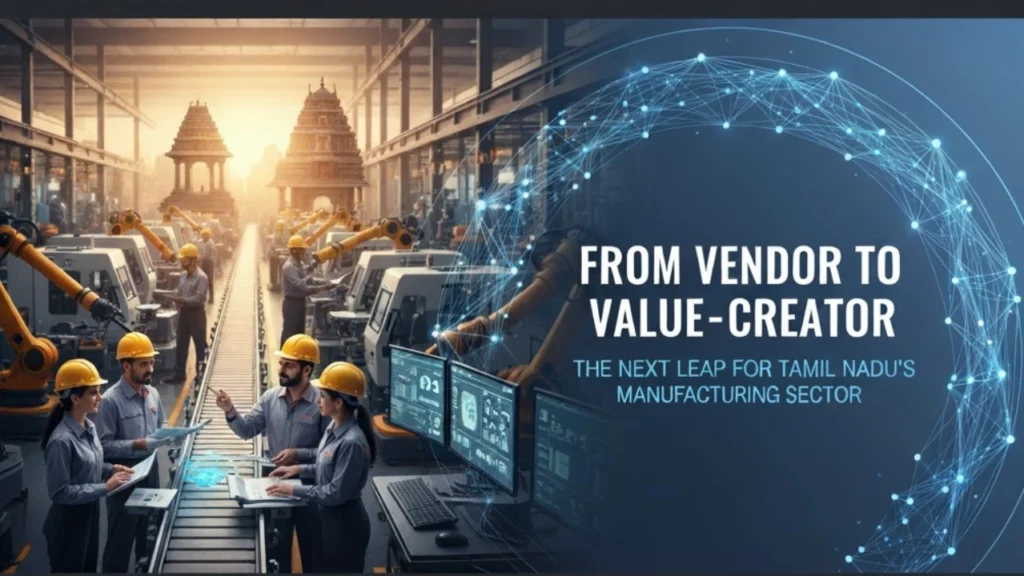
From Legacy to Leadership – A Consultant’s Perspective
When you walk through the vast industrial belts of Chengalpattu, Hosur, or Pudukottai in Tamil Nadu today, you don’t just see factories—you witness a quiet but powerful transformation. From being a southern gateway to India, Tamil Nadu has emerged as one of the most resilient, scalable, and future-ready destinations for FMCG manufacturing.
This shift didn’t happen overnight. It’s a result of decades of groundwork—strategic planning, infrastructure investments, and pro-industry policymaking.
As someone who’s worked with both Indian and global firms exploring market entry, sourcing, and expansion strategies across the country, I believe Tamil Nadu’s FMCG playbook deserves national and global attention.
From Traditional Trade to Modern Manufacturing
Historically, Tamil Nadu has been a hub for textile exports, leather goods, and agri-based trading. Cities like Coimbatore and Erode built their legacy in cotton and turmeric, while Tuticorin emerged as a key port for food grains and salt.
But the turning point came in the early 2000s, when Tamil Nadu began diversifying beyond its legacy sectors. The government, recognizing the rising demand for processed food, personal care, and packaged goods, rolled out:
- Industrial Policy 2003 & 2007 – with capital subsidies and land allotment incentives
- Establishment of SIPCOT parks with sector-specific infrastructure
- Seamless logistics support through upgraded road, rail, and port infrastructure
This shift laid the foundation for the FMCG surge we see today.
Why FMCG Giants Are Betting Big on Tamil Nadu
In the last 5 years, there’s been an unmistakable uptick in FMCG investments into Tamil Nadu—and for good reasons:
1. Strategic Location & Export Readiness
Tamil Nadu boasts three major ports (Chennai, Ennore, Tuticorin) and proximity to Southeast Asia. For FMCG brands with global footprints, this translates to reduced lead times and export-friendly cost structures.
2. Plug-and-Play Industrial Ecosystems
With over 50+ industrial parks, Tamil Nadu offers everything an FMCG unit needs:
- Ready land parcels
- Warehousing and cold chain facilities
- Water, power, and effluent management systems
- Single-window approvals via the Tamil Nadu Industrial Guidance Bureau
3. Talent & Skilling
Tamil Nadu produces over 3.5 lakh graduates annually, many from engineering and life sciences backgrounds. Complementing this is the Tamil Nadu Skill Development Mission (TNSDM), which has been instrumental in training the local workforce for shop-floor and quality roles in FMCG units.
4. Power Surplus & ESG Compliance
With a strong mix of renewable energy (wind, solar) and a steady power surplus, Tamil Nadu supports green manufacturing—a critical factor for sustainability-focused FMCG multinationals.
The Godrej Greenfield Benchmark
Let’s zoom into a live example—Godrej’s new integrated FMCG manufacturing facility at OneHub Chennai Park, Chengalpattu.
- Built across 12 acres, this plant manufactures biscuits, snacks, chocolates, and instant food categories
- Aligned with Industry 4.0 principles—ensuring automation, traceability, and lean production
- Designed to serve both domestic and overseas markets (Asia, Africa, Latin America)
- Creates inclusive growth by hiring women from local communities, trained by Godrej’s skilling programs
This isn’t just a factory. It’s a blueprint for how future FMCG plants in India could and should look—efficient, export-ready, and community-inclusive.
Recent Growth Trends
According to Kepler’s internal industry analysis:
- FMCG-related capex in Tamil Nadu grew by 28% CAGR between FY2018–FY2023
- Snack food, dairy, and hygiene products led the investment chart
- Demand from urbanising Tier 2/3 towns like Tiruchy, Salem, and Madurai has fueled regional distribution centres
- The post-COVID period saw a resurgence in local manufacturing to de-risk supply chains
Companies like Nestlé, HUL, Britannia, ITC, Hatsun, and CavinKare continue to scale up in the state, either directly or through contract manufacturers.
Government Support That Enables Scale
The state has institutionalized a business-first approach, with:
- Guidance Tamil Nadu (single window for approvals)
- TN Food Processing Policy 2021 with subsidies on plant & machinery, and power tariffs
- Capital subsidies up to ₹10 crores for eligible FMCG projects in backward districts
- Ease of doing business rating: Tamil Nadu ranked among the Top 3 states in DPIIT’s national index
This is a far cry from the slow, bureaucratic image often associated with Indian states.
Consultant’s Take: Tamil Nadu in the Next Decade
As a market research consultant, I see Tamil Nadu’s FMCG journey moving from cost arbitrage to capability building. The next phase will likely focus on:
- R&D centres and product innovation labs within FMCG clusters
- Co-manufacturing models to support mid-size brands looking to scale
- Increased ESG reporting and traceability in food chains
- Growth in nutraceuticals, clean-label snacks, and plant-based alternatives
Our recent feasibility study for a European FMCG client exploring contract manufacturing options clearly showed that Tamil Nadu scored highest across 7 decision metrics, from land access and labor cost to freight availability and power reliability.
Final Word: A Model for Emerging India
Tamil Nadu has quietly built what many other states are still aspiring to create—a seamless, scalable, and socially inclusive manufacturing ecosystem for consumer goods.
It’s no longer a backup location. It’s a first-choice investment zone for serious FMCG players, both Indian and global.
If you are an investor, manufacturer, or trade consultant exploring FMCG opportunities in India, Tamil Nadu is where you should start looking.