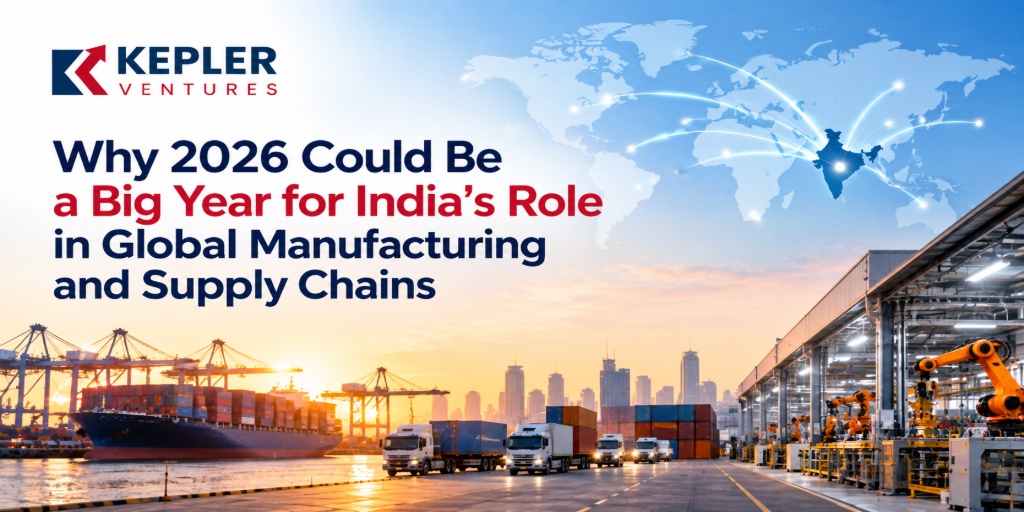
As the world gradually changes where things are made, the year 2026 keeps cropping up in boardrooms, sourcing talks, and policy circles.
This isn’t due of one declaration or reform. It’s because several long-term changes, trade policy, industrial competence, logistical reform, and demands for sustainability are all going to happen at the same time. They put India at a crossroads: it can either become a reliable global manufacturing hub or stay an alluring but unreliable option.
The chance is real. But turning it into leadership will depend a lot more on how well you do it than how much you want it.
A global supply chain reset is happening, and India is clearly in the picture.
It’s not only about saving money anymore when it comes to global supply networks. Companies have had to reassess concentration risk because of geopolitical unpredictability, tariff shocks, and frequent interruptions. The old “China+1” method is being replaced by “multi-country continuity,” where reliability, compliance, and predictability are just as important as price.
India’s signals are important in this situation, and people are keeping a close eye on them.
India is anticipated to grow by about 6.5% in FY2024–25, which is more than most other big economies. Merchandise exports are close to US$440 billion, and foreign direct investment has gone above US$80 billion. This shows that people throughout the world still believe in India’s long-term industrial potential.
India’s Logistics Performance Index ranking of 38 suggests that things are getting better, but it also shows a big problem. Not only do the world’s top manufacturing centers fight on price, but they also compete on “logistics certainty.” In the years to come, that gap will be even more important.
What makes 2026 feel different
Timing is what makes 2026 different. Changes in structure that started years ago are now influencing the ground.
Trade policy goes from promise to payout
Several trade agreements, the most important of which is with Australia, as well as talks with the UK, the EU, and key Gulf markets, are projected to start providing real tariff reduction and market access benefits around 2026.
This means that exporters are going from policy intent to business reality. Pricing becomes more competitive, and demand becomes clearer both of which are necessary for making investments in manufacturing.
Industrial policy is now in the delivery phase
Incentives like the Production-Linked Incentive (PLI) schemes, along with improvements to infrastructure and changes to labour laws, are slowly moving beyond just creating more capacity. Not merely output numbers will be used to measure their success by 2026. Instead, it will be based on supplier depth, ecosystem strength, and value-chain integration.
Sustainability is no longer up for debate
Sustainability is no longer a side issue. Global purchasers are making Scope 3 emissions reporting and carbon disclosure requirements stricter, which means that energy sourcing and compliance readiness are now commercial considerations.
India’s fast growth in renewable energy, which already includes more than 130 GW of installed solar capacity, is a real benefit, especially for industry that uses a lot of energy and exports a lot of goods.
Where India can go and where the constraints still show
Electronics and components: India has gained ground in electronics assembly and EMS work. Better access to commerce might help the country move farther into parts, testing, and subsystems.
The problem is that we depend on imported semiconductors, supplies, and equipment, and customs and logistics can change.
Supply chains for cars and electric vehicles: OEMs throughout the world are continually looking for new sources. India is good in making castings, forgings, wire harnesses, and mechanical systems. There are also more chances to work on EV controllers and power electronics.
The problem is that Tier-2 and Tier-3 suppliers are not all at the same level of maturity, and the company still relies on imported batteries and other important supplies.
Capital goods and industrial machinery: More money is being spent on infrastructure around the world, which is helpful for India’s engineering talent and mid-cost manufacturing base. The problem is that there are gaps in precise manufacturing, metrology, certification timelines, and after-sales reliability.
Pharmaceuticals and specialty chemicals: India is still an important supplier to global markets, and trade agreements make it easier for regulated economies to get what they need. The constraint is: stricter compliance checks, being ready for audits, and relying on raw materials.
Green manufacturing and renewable energy: As the world move toward cleaner energy faster, India’s clean power scale makes it easier for the country to compete on more than simply labour costs. The problem is that solar and storage technologies depend on things that happen upstream, and the grid and storage need to be ready.
The risks of execution that could make the moment weaker
India is nonetheless held back by four fundamental problems, even though things are going well for it.
- Logistics variability: Unpredictability—delays at ports, customs clearance cycles, and variations in the first and last mile—often eats away at cost advantages. Increasingly, global purchasers care more about reliability than headline savings.
- Gaps in mid-tier suppliers: Top-tier OEMs follow global standards, while many Tier-2 and Tier-3 suppliers have trouble with process discipline, traceability, and consistent delivery. After 2026, addressing problems on the go won’t be enough anymore.
- Integration at a shallow level: Success that is mostly based on assembly does not mean that you have control over the value chain. Leadership necessitates enhanced localization of materials, components, and production equipment.
- Exposure to policy and tariff shocks: Short-term incentives like RoDTEP, which will last until March 2026, provide them some breathing room. But subsidies won’t make a business competitive in the long run. Instead, productivity, compliance, and quickness will.
What India needs to do in 2026
If India wishes to turn opportunity into leadership, it needs to change its objectives from growth to action:
- Lowering logistics cost is not enough; we also need to lower logistics variability.
- Expanding “systematic supplier development,” notably for companies in Tier 2 and Tier 3
- Making it easier to get clean, dependable industrial energy Speeding up testing, certification, and standards infrastructure
- Lowering the cost of capital and speeding up project completion times
These are not small fixes. They will decide if India becomes a “default sourcing destination” or stays a strong choice with conditions.
The verdict of 2026
India starts 2026 with a lot of energy, more trade opportunities, and a rising industrial base. But being the biggest manufacturer in the world doesn’t mean you’re the best.
It is predicated on trust at scale, which means being able to deliver on time, with consistent quality, and with compliance and resilience integrated into the system.
If India uses 2026 to solve its execution deficiencies, especially in logistics reliability, supplier depth, and sustainability integration, the story will change for good. India will not be called an “emerging alternative” anymore; instead, it will be called a core pillar of global manufacturing and supply chains.
The year ahead will reveal which path India ultimately chooses.