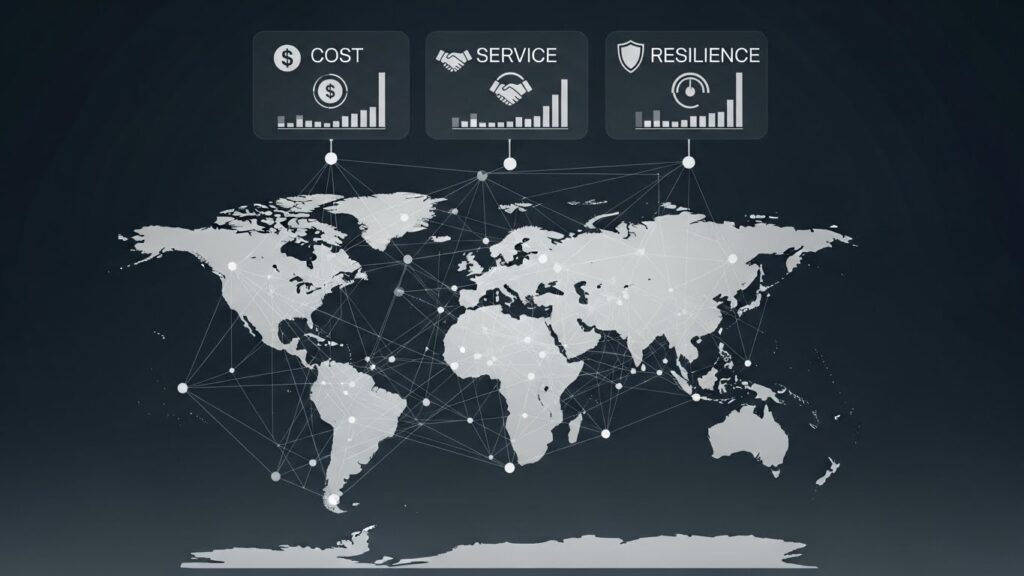
Businesses can optimize their supply chain networks to develop efficient factory, warehouse and transportation routes which reduce costs while delivering superior customer service and creating financial flexibility and improving operational stability through scenario-based modelling and execution planning.
Why network optimization is the highest-leverage supply chain decision
The current network of supply chains receives most attention from supply chain initiatives which work to enhance their operational performance through better forecasting and freight rate negotiations and safety stock optimization and warehouse efficiency enhancement and production timing adjustments. The network infrastructure prevents these implemented initiatives from reaching their complete potential.
A supply chain network functions as the physical and logical framework which transports products starting from suppliers through factories and warehouses until they reach their destinations at customer locations. It includes:
- The number and location of plants, co-manufacturers, and suppliers
- The organization needs to determine the number of distribution centers (DCs) and their size and strategic locations for hubs and cross-docks.
- The routes and lanes connecting nodes
- The flow strategy (direct ship, hub-and-spoke, regional stocking, postponement, etc.)
- The service promise to the customers (lead times and delivery frequency and order minimums) imply
- The risk exposure created by concentration (single ports, single plants, single regions)
Network design choices determine both operational expenses and service delivery on a daily basis because they possess substantial power in network operations. A network designed properly minimizes the requirement for expedited work and extended working hours and storage of excess materials and regular network redesign. A network design that lacks proper planning requires organizations to make continuous adjustments between their inventory levels and their transportation speed and their service quality.
“Network optimization stands as the most sophisticated yet difficult supply chain management solution which businesses can implement.”
What supply chain network optimization means
Organizations need to use a systematic method to optimize their supply chain networks because this approach helps them discover their most effective network design which achieves their business objectives. The system provides solutions to questions which include:
- What locations should we choose for product manufacturing and storage and distribution operations?
- The system requires an unspecified number of DCs which do not have defined service duties.
- Which customers should be served from which nodes?
- We need to determine which transport modes and lanes we should select for each segment of the journey.
- Should we ship direct, consolidate at hubs, or use cross-docks?
- Our company should store inventory at what locations: we should choose between storing inventory at central locations or regional locations or locations which are close to our customers.
- What methods exist to achieve equilibrium between cost expenses and service delivery and cash management and risk mitigation?
Network optimization exists as a mathematical model which serves as its foundation. It is a decision framework that blends:
- Data-driven scenario analysis
- Commercial strategy (customer promise, growth plans)
- Operational constraints (capacity, lead times, regulations)
- Risk and resilience thinking (redundancy, flexibility)
- A practical implementation plan (phasing, transitions, contracts)
Typical outcomes of network optimization focus on:
Network optimization which is performed correctly leads to better results in four specific areas:
1) Cost
- The transportation costs decrease because of improved lane arrangements and route combination.
- The company achieved cost reduction in warehousing through warehouse optimization which combined warehouse size optimization with storage area elimination.
- The new structure will decrease both expediting costs and premium freight expenses.
- The system decreases handling expenses because it minimizes the number of product contacts and creates the most efficient product transportation routes.
2) Service
- The delivery process now delivers fast service to customers who need quick and dependable delivery.
- The OTIF performance improved because of enhanced product placement which reduced the number of times products needed to be transferred between locations.
- A business needs an accurate inventory management system to achieve its goal of maintaining proper product stock levels.
3) Cash
- The total inventory amount decreases because the system eliminates duplicate items while it enhances product movement.
- The system requires less safety stock because it achieves better lead-time reliability.
- The company will achieve improved working capital performance because it will reduce its need for emergency financial reserves.
4) Resilience
- The system decreases the risk of concentration which affects ports and plants and specific geographic areas.
- The network achieves improved disruption recovery because it uses backup routes together with duplicate infrastructure systems.
- The optimized delivery routes minimize environmental impact through their combination of distance optimization with delivery consolidation and transportation mode selection.
“The process requires you to choose which outcome delivers the most value for each market segment because different networks have restricted abilities to accomplish all possible results at once.”
The most common triggers for network optimization
Organizations start network optimization programs after they detect one or more specific triggers which activate the process.
- The network expanded at a rapid pace into new territories which its designers had not planned for.
- Service deterioration (late deliveries, rising customer complaints)
- Freight cost inflation or volatility (network overly dependent on expensive modes)
- Mergers and acquisitions (duplicate sites and overlapping flows)
- New product portfolios (different storage, temperature, or regulatory needs)
- Manufacturing footprint changes (new plant, contract manufacturing, outsourcing)
- Risk events (port disruptions, geopolitical shifts, supplier concentration)
- Sustainability targets (emissions