

For a good few years, plenty of companies treated artificial intelligence as a technology to-do list: pick some tools, run a few pilots, automate the obvious tasks, and watch where the value turned up. When the whole point was learning, that made sense. It gets expensive fast once AI starts moving into core workflows, customer experiences, actual products and multi-year investment plans.
At that stage the questions shift. Which business problems are important enough to be worth solving with AI in the first place? Where does it create real economic value rather than a clever demo? What do you build in-house, what do you buy off the shelf, and what do you reach through a partner? What has to change in how the company actually runs? And how does the board judge return, risk and adoption?
Those aren’t technology questions. They’re strategy questions, bound up with capital allocation, competitive advantage, organisation design and execution, not just which vendor to sign.
The 2026 numbers underline the shift. PwC found that 66% of India CEOs were more worried about keeping up with technology and AI, against 42% globally. Deloitte’s State of AI in the Enterprise India work reported at-scale deployment in product development (62%), strategy and operations (56%), marketing and sales (55%) and supply chain (48%). AI has already reached the functions that most directly shape growth, cost and where a company wins.
Key Takeaways
- Begin with business value, not a shopping list of AI use cases.
- Treat AI spend the way you would any investment portfolio, with different return profiles and different levels of risk sitting side by side.
- Make a deliberate call on what to build, what to buy and what to reach through partners, rather than defaulting to one of them.
- Redesign the workflow and the decision rights around it. Dropping AI on top of a broken process just gives you a faster broken process.
- Measure adoption, economics, risk and strategic advantage, not only whether the model performs well on paper.
Why AI Has Become a CEO-Level Strategy Issue
AI touches revenue, cost, speed, risk, customer experience and the shape of work itself. That puts it in the same bracket as any large strategic investment: the value depends on where you choose to point it, how far it changes the business model, and whether the organisation can actually absorb the change.
And the real risk isn’t only underinvesting. It’s spreading too thin, funding a scatter of unconnected pilots and ending up with a tall stack of tools and no clear economic thesis underneath them. What leadership needs is a portfolio view of AI, not a drawer full of departmental experiments.
Which is why AI priorities belong inside the company’s wider corporate strategy and growth advisory agenda, especially once they start touching capital allocation, customer propositions, operating models or the basis on which the company competes.
The CEO AI Investment Framework
| Decision | CEO Question | Expected Output |
|---|---|---|
| Business Problem | What important problem are we solving? | Prioritised use-case thesis linked to strategy |
| Economic Value | How will value show up? | Revenue, cost, risk, speed or working-capital case |
| Build / Buy / Partner | What must we own? | Sourcing and capability model |
| Operating Model | What workflow and role changes are required? | Future-state process and decision design |
| Capabilities | What skills, data and platforms are missing? | Capability roadmap |
| Governance | What risks and controls matter? | Accountability, data, model and human oversight |
| ROI & Horizon | How and when will return be measured? | Investment case and milestone plan |
| Scale Decision | What evidence triggers expansion? | Stage gates and portfolio reallocation rules |
1. Start With the Business Problem, Not the Technology
A weak AI agenda opens with “Where can we use AI?” A stronger one opens with “Which strategic or operational problems are actually worth solving, and what’s the economic impact if we do?” It sounds like a minor reword. It completely changes the quality of what ends up in your investment pipeline.
High-value problems tend to look like this: cutting engineering cycle time, sharpening forecast accuracy, lifting sales productivity, automating high-volume service work, catching quality failures earlier, making smarter procurement calls, or shortening time to market. The right list depends entirely on your industry and business model.
Whatever the use case, it needs an owner, a baseline, a measurable outcome, and a real reason AI beats the alternatives, ordinary automation, process redesign or plain analytics, at solving that particular problem.
2. Define the Economic Value
AI ROI gets talked about far too loosely. CEOs should push for a clear line from technical capability to financial or strategic impact. Broadly, value shows up through five channels: revenue growth, cost reduction, risk reduction, speed, and capital efficiency.
| Value Lever | Examples | Useful Measures |
|---|---|---|
| Revenue | Better conversion, personalisation, faster innovation, new services | Incremental revenue, conversion, share of wallet |
| Cost | Automation, productivity, lower rework, better planning | Cost per transaction, labour hours, cost-to-serve |
| Risk | Fraud, quality, compliance, supply disruption | Loss avoided, defect rate, incident frequency |
| Speed | Faster decisions, product development, response time | Cycle time, lead time, time-to-market |
| Capital Efficiency | Forecasting, inventory, asset utilisation | Working capital, inventory turns, utilisation |
Some initiatives will carry a direct financial case. Others earn their place through strategic option value: better data, faster experimentation, or a capability that will simply be table stakes for competing later. The discipline is to name the kind of value honestly instead of squeezing every project into a made-up short-term ROI number.
3. Build, Buy or Partner?
Not every AI capability deserves to be built in-house. The call should turn on how much it differentiates you, how sensitive the data is, how fast you need it, whether the talent exists, the economics, and how much control you require.
Buy when the capability is fairly standard, the vendor market is mature, and owning it yourself buys you little. Build when it’s wired into your proprietary data, your IP, your core workflows or a genuinely durable advantage. Partner when speed is the priority, the field is moving quickly, or you need specialist help before you even know what’s worth internalising.
Most companies land on some hybrid of the three. The strategic discipline is in being clear about what has to stay distinctive and what you’re happy to treat as a commodity.
4. Redesign the Operating Model, Not Just the Tool Stack
AI tends to disappoint when it’s bolted onto an existing workflow without anyone touching the roles, approvals or decision rights around it. If your people still have to run every old step after the system produces an answer, cycle time doesn’t budge. If managers don’t trust the output, the model can be technically excellent and operationally beside the point.
The future-state workflow has to spell out what AI handles, what people handle, where human judgement is non-negotiable, who owns the exceptions, what data feeds it, and how you’ll measure whether it’s working.
For a lot of organisations, that makes operating model transformation a core part of getting any value from AI at all. Workflow design, capability planning, performance management and change adoption are what decide whether the technology actually shifts the economics of the business.
5. Build the Capabilities That Strategy Requires
The capability gap is almost never just “we need more data scientists.” You’ll often need stronger data engineering, sharper product management, clear process ownership, model governance, cybersecurity, deep domain expertise and serious change management. Business leaders, for their part, need enough AI fluency to make investment and risk calls without quietly handing the whole agenda to the tech team.
A capability roadmap should separate three things: skills that have to live inside the company, skills that can be pooled centrally and shared, and specialist capabilities you’re better off sourcing from outside.
6. Governance Is a Value Enabler, Not Just a Control Function
As AI works its way into customer, employee and operational decisions, governance needs to be designed in early rather than bolted on later. That covers data access, privacy, cybersecurity, model performance, human oversight, vendor risk, IP, and clear accountability for decisions AI has a hand in.
Done well, governance actually speeds adoption up, because everyone knows where AI is fair game, what controls apply, and who’s on the hook. Done badly, you get the worst of both worlds: unchecked experimentation in some corners and paralysing caution in others.
7. Measure ROI Over the Right Horizon
AI programmes usually blend quick wins with foundational bets. A service-automation use case might pay back in months. Building a genuinely good data foundation, reworking a product development process, or threading AI through a complex supply chain will take a lot longer.
So the board should read AI as a portfolio with mixed horizons. Track direct financial impact where it’s there, but also watch adoption, cycle-time gains, quality, customer outcomes, risk and how fast capability is maturing. Lean on a single ROI figure and you’ll miss whether something is quietly building real strategic value.
8. Create Stage Gates Before Scaling
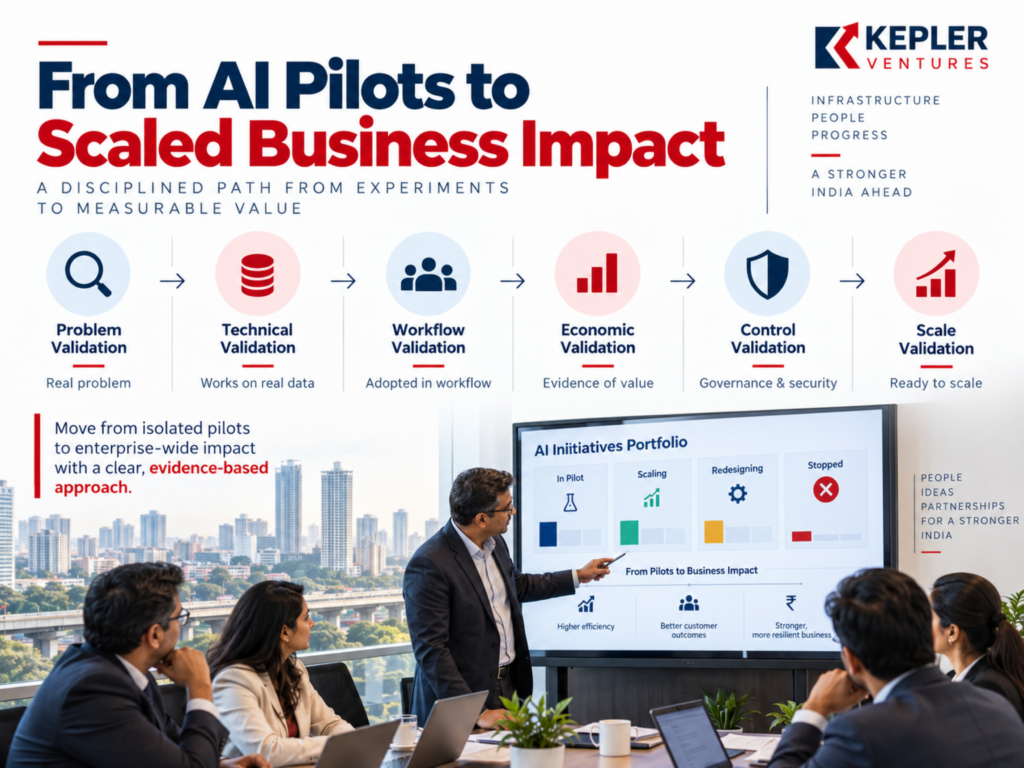
The surest way to dodge both pilot paralysis and runaway spending is to put stage gates in place. An initiative has to earn the right to scale by clearing evidence thresholds along the way.
- Problem validation: is the business problem real, significant and measurable?
- Technical validation: can the solution actually perform at an acceptable level on the data you have?
- Workflow validation: will employees and managers use it inside the real process, not just in a demo?
- Economic validation: is there evidence of revenue, cost, speed, risk or capital impact?
- Control validation: are governance, security and accountability solid enough to scale?
- Scale validation: can it roll out across teams, sites or customer segments without the complexity ballooning?
What CEOs Should Ask Before Approving the Next AI Budget
- Which three business outcomes does our AI portfolio actually need to move this year?
- Which of these initiatives are genuine differentiators, and which are just productivity tools?
- What value did we really get from the last round of spending?
- Which workflows have to change for any of this to pay off?
- What proprietary data or knowledge gives us an edge nobody else has?
- Where are we leaning on vendors, and are we comfortable with that dependency?
- What are our biggest governance, cybersecurity and adoption risks?
- Which pilots should we kill, scale or redesign?
- And what evidence would actually justify releasing the next tranche of capital?
A Practical 90-Day AI Strategy Agenda
If you already have pilots running but no coherent enterprise agenda tying them together, the fix doesn’t have to be a multi-year transformation programme. A focused 90-day cycle can bring the clarity you’re missing.
| Period | Focus | Output |
|---|---|---|
| Days 1–30 | Portfolio fact base | Inventory initiatives, spend, owners, outcomes, data and dependencies |
| Days 31–60 | Prioritisation and design | Select strategic use cases, define economics, sourcing model, workflow and governance |
| Days 61–90 | Execution roadmap | Stage gates, capability plan, operating-model changes, metrics and capital allocation |
Why This Matters Now in India
India’s enterprise AI adoption has clearly moved past the experiment stage. Deloitte’s 2026 research shows at-scale deployment across product development, strategy and operations, marketing and sales, and supply chain. PwC’s CEO survey adds a useful wrinkle: companies with broader, stronger AI foundations were more likely to report both revenue growth and cost reductions. The takeaway for CEOs isn’t that everyone should spend more. It’s that the quality of the investment, how well it’s integrated, and how well it’s executed matter more and more as AI sinks deeper into the enterprise.
The edge won’t come from owning the same tools everyone else owns. It’ll come from pointing AI at the right problems, drawing on data and capabilities others don’t have, redesigning work properly, and reallocating capital faster than rivals when the evidence changes.
From AI Experimentation to Business Strategy
The next chapter of AI is less about proving the technology can work and more about deciding where it actually should matter. That calls for the same disciplines as any serious strategic investment: set the objective, understand the economics, choose the operating model, build the capabilities, manage the risk, and hold the whole thing accountable to evidence.
Kepler’s advisory engagements point to the same underlying lesson: value gets created when analysis, operating decisions and execution are joined up, not run as separate workstreams that never quite meet.
Final Thought
AI shouldn’t turn into a technology budget hunting for a business case. For a CEO, the question is where AI can sharpen competitive advantage, improve the economics, or change how the organisation creates value in the first place. Frame it that way, and the conversation moves from tools to strategy, and from endless experimentation to disciplined investment.