
India’s construction equipment market is entering an important phase of development, and the direction it takes will shape opportunities across the entire value chain.
Held from 15–18 September 2026 at the India Expo Centre in Greater Noida, bauma CONEXPO India 2026 provided a platform for stakeholders across construction machinery, mining machinery, building-material machinery, components and services.
The broader significance of the event extends beyond the machines displayed and technologies introduced. It reflects the changing basis on which Indian buyers now evaluate equipment.
As a result, buyers are now looking beyond acquisition cost and technical specifications. Productivity, uptime, fuel efficiency, service support, digital connectivity, lifecycle economics and return on investment are becoming more important in equipment decisions.
For manufacturers, component suppliers, technology providers and investors, this raises a larger question: where will the next opportunities emerge, and what capabilities will companies need to capture them?
Moreover, the sheer scale of the construction equipment market makes that question important. In February 2026, the Ministry of Heavy Industries cited industry estimates placing India’s construction equipment market at around USD 9.5 billion, with sales exceeding 140,000 units in FY25. The Ministry also cited an industry estimate that the market could grow to approximately USD 25 billion by 2030.
Infrastructure Remains the Foundation of Construction Equipment Market Demand
Demand in India’s construction equipment market remains closely linked to the country’s infrastructure and industrial investment cycle. The FY2026–27 Union Budget provides approximately ₹12.22 lakh crore for capital expenditure, reinforcing the importance of infrastructure-led growth for sectors connected to construction equipment.
Roads and highways remain major demand drivers. However, the opportunity extends across a broader set of sectors, including:
- Rail and metro projects
- Mining and mineral processing
- Airports and ports
- Urban infrastructure
- Logistics and warehousing
- Water and irrigation projects
- Renewable-energy infrastructure
- Tunnelling and underground construction
- Industrial facilities
- Emerging industrial projects, including data centres and semiconductor facilities
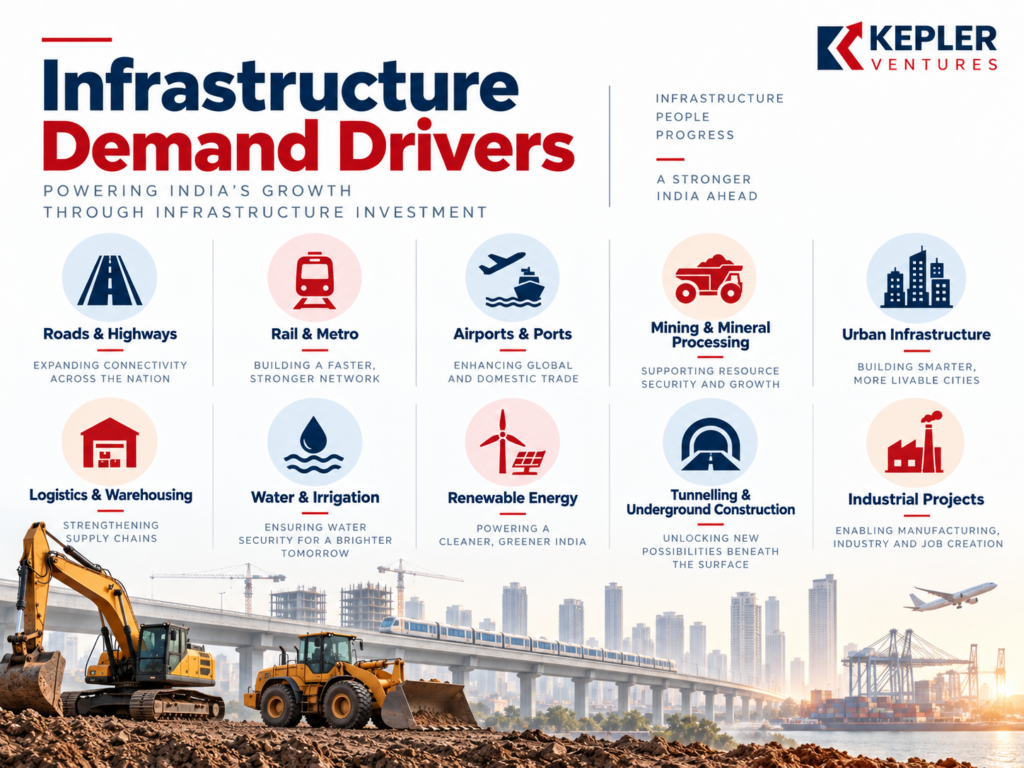
In addition, the broader industry discussion around bauma CONEXPO India pointed to a more diversified demand environment, with specialised equipment required for different applications and operating conditions.
In other words, companies cannot treat India as one homogeneous construction equipment market. Demand patterns, customer economics, applications, price expectations and service requirements vary materially by segment and geography. Consequently, market intelligence and segment-level opportunity assessment are becoming more important for companies evaluating growth.
The Industry Is Moving From Machine Specifications to Business Outcomes
The basis of competition is also changing. Purchase decisions that once centred heavily on specifications and acquisition price now place greater weight on measurable operating outcomes.
Customers are paying closer attention to:
- Machine uptime
- Fuel consumption
- Utilisation
- Maintenance requirements
- Availability of spare parts
- Service turnaround time
- Operator productivity
- Digital visibility
- Equipment lifecycle
- Total cost of ownership
The industry conversation around bauma CONEXPO India 2026 reflected this transition from specifications towards measurable operational outcomes. In particular, productivity, digitalisation, sustainability, localisation and service readiness were recurring themes around the 2026 edition.
However, a technically strong machine can still struggle if the manufacturer cannot build the dealer network, spare-parts infrastructure, service capability and customer support needed to keep equipment productive.
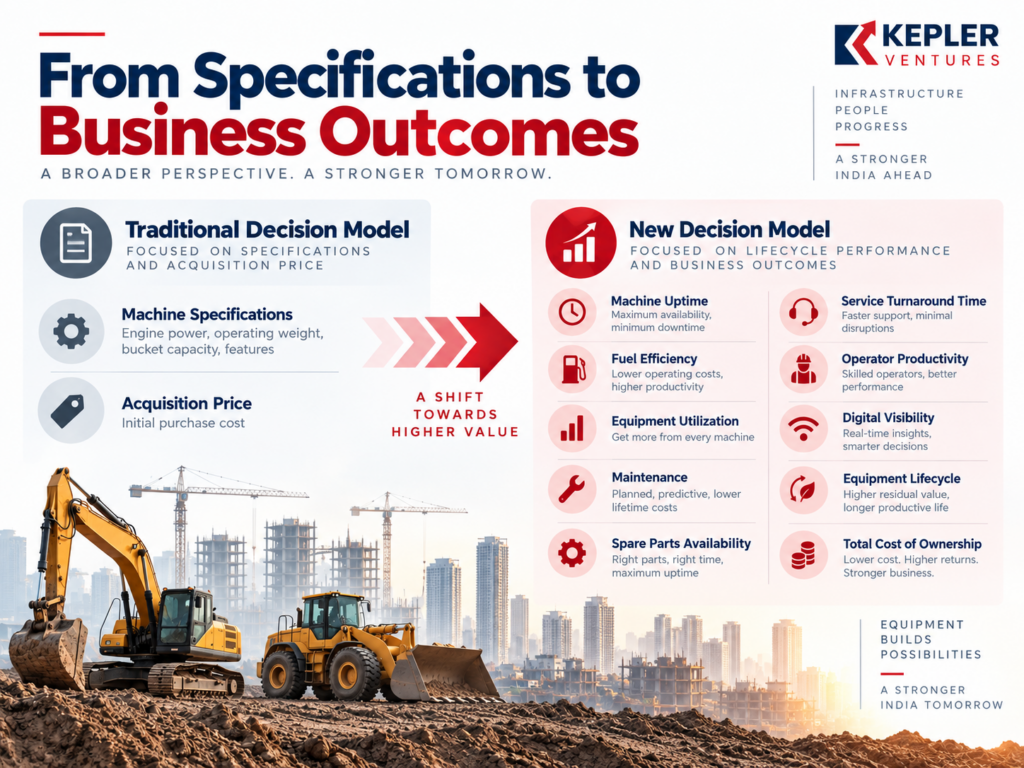
For companies entering or expanding in India, the question is therefore no longer simply, ‘Can our product compete?’ It is equally important to ask, ‘Can our complete operating model compete?’
Localisation Is Becoming a Strategic Capability in the Construction Equipment Market
Localisation is becoming a strategic choice rather than only a cost-reduction exercise. As the domestic market develops and India strengthens its role as a manufacturing and sourcing base, companies are evaluating how much of their product, component base and supply chain to develop locally.
Well-designed localisation can improve cost competitiveness, shorten supply chains, strengthen responsiveness and help companies adapt products to Indian operating conditions. However, the decisions are complex.
Companies need to determine:
- Which components to source locally
- Which capabilities should remain global
- Whether to import, assemble or manufacture
- Which suppliers can consistently meet quality and delivery requirements
- How localisation changes product economics
- Where to locate manufacturing facilities
- How to manage supply-chain and single-source risks
Localisation, technology partnerships and collaboration between international technology owners and Indian manufacturers were among the key themes associated with the 2026 edition of bauma CONEXPO India.
For global OEMs, this creates an opportunity to build a more competitive Indian operating model. Similarly, for Indian component manufacturers, it creates an opportunity to participate more deeply in domestic and global supply chains.
India Is Increasingly Both a Market and a Manufacturing Base
For global equipment companies, companies should increasingly evaluate India from two perspectives: as a large domestic market and as a potential manufacturing, sourcing and export platform.
Meanwhile, the export story is becoming more visible. According to ICEMA data, India’s construction equipment exports increased by approximately 31.5% year-on-year in FY26 to around 17,400 units, even as domestic sales declined during the year.
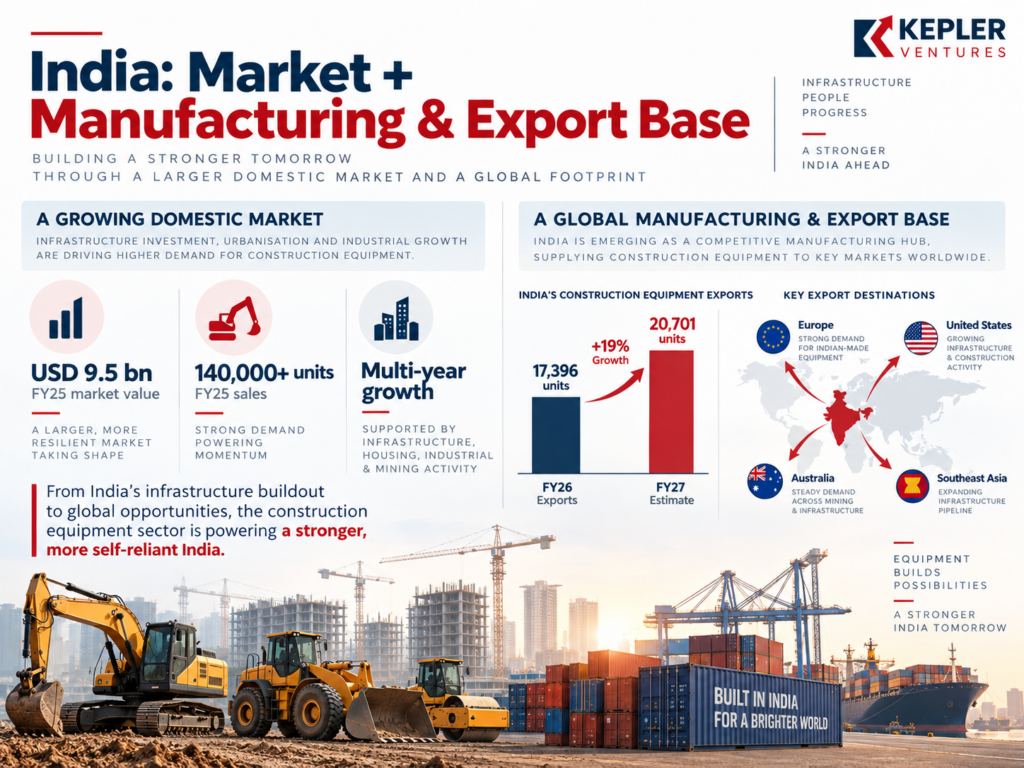
The current FY27 outlook is also notable. ICEMA estimates that construction and infrastructure equipment exports could reach approximately 20,701 units in the financial year ending March 2027, up from approximately 17,400 units in FY26. The association has linked the outlook to growing demand across international markets, including Europe, the United States, Australia and Southeast Asia.
This does not mean every manufacturer should automatically establish an export-oriented base in India. Instead, it means that market-entry decisions should consider the country’s role in the company’s wider value chain, not only its domestic sales potential.
Digitalisation Is Reshaping the Construction Equipment Market
Construction equipment is becoming more connected, and digitalisation is moving closer to the core operating proposition of many equipment categories.
Telematics, connected-machine monitoring, remote diagnostics, fleet management and predictive maintenance are becoming more relevant because they can improve how equipment is operated and supported.
The commercial value of digitalisation lies in measurable results: improved utilisation, earlier fault detection, more efficient maintenance planning, reduced downtime, better fuel management and stronger fleet visibility.
This distinction matters. Customers are unlikely to adopt technology simply because it is new. Instead, adoption is more likely where digital tools demonstrate a clear improvement in productivity, reliability, safety, serviceability or lifecycle economics.
Electrification and Sustainability Will Develop Application by Application
Electric equipment, hybrid powertrains, alternative fuels and more efficient machines are attracting attention, but adoption is unlikely to progress at the same pace across every equipment category.
Specifically, the commercial case depends on duty cycle, charging or fuelling infrastructure, machine size, operating hours, site conditions and customer economics. In some applications, electrification may scale faster; in others, conventional and alternative powertrains are likely to coexist for longer.
Manufacturers also need to look beyond propulsion. Regulatory readiness, circularity, recycling, value-chain mapping and the sustainability performance of the wider operating model will become more relevant as customers and regulators raise expectations.
Aftermarket Services Will Set Leaders Apart in the Construction Equipment Market
As India’s installed base of construction equipment expands, the aftermarket becomes a larger strategic opportunity.
Equipment sales create recurring requirements for spare parts, maintenance, repairs, diagnostics, component replacement, refurbishment, fleet optimisation and operator support.
In many equipment categories, the aftermarket relationship may determine whether a customer remains loyal to a brand. Parts availability, technician response time, remote diagnostics, refurbishment capability and operator support can influence repeat purchases as much as the original machine specification.
For new entrants, this has a direct implication: companies should design after-sales support as part of the market-entry model rather than treat it as an activity that follows equipment sales.
Market Entry Into India Requires More Than Identifying a Distributor
India continues to attract global OEMs, component suppliers and technology companies looking for growth. However, a distributor alone rarely constitutes a complete market-entry strategy.
Companies entering India need to answer a practical set of questions:
- Which customer segments offer the strongest opportunity?
- Which products are suited to Indian applications and operating conditions?
- How should the company price and position its products?
- What level of localisation is commercially justified?
- Which channel and dealer model will work?
- What financing models will customers require?
- Is a rental or leasing model more appropriate for the target segment?
- What after-sales infrastructure is required?
- Which suppliers, technology partners or manufacturing partners should the company develop?
- Where should the company build direct capabilities rather than rely on partners?
Successful market entry therefore requires a combination of market intelligence, localisation, business-model design, partner selection, service planning and execution.
Where Opportunities Are Emerging in the Construction Equipment Market
The next phase of India’s construction equipment market creates opportunities across several parts of the value chain.
For global OEMs, India offers routes to market expansion, localisation and manufacturing. Indian manufacturers, meanwhile, can use domestic scale to support product development and internationalisation. Similarly, localisation can open new OEM relationships for component and sub-system suppliers. Technology companies can find practical new use cases in connected equipment and intelligent fleet management. In addition, a growing installed base creates recurring service opportunities for aftermarket businesses. Finally, investors can look across an ecosystem that includes manufacturing, components, technology, rental, service and specialised-equipment opportunities.
The strategic question is therefore not simply whether an opportunity exists. It is where a company should participate in the value chain, what capabilities it needs to build and which execution model is most likely to create sustainable advantage.
How Kepler Ventures Supports Companies in the Construction Equipment Market
At Kepler Ventures, we help companies move from market opportunity to practical execution across the construction equipment ecosystem. Our role goes beyond identifying attractive segments; we also support the decisions, partnerships and operating capabilities required to compete successfully in India.
Market Intelligence & Strategy
We deliver market sizing and forecasts, demand and segment analysis, competitor benchmarking and opportunity assessment to establish where the most attractive opportunities exist and how to prioritise them.
Market Entry & Growth
Go-to-market strategy, localisation strategy, business models, channel and dealer strategy and growth roadmaps for companies entering India or expanding into new segments.
Procurement & Supply Chain
Strategic sourcing, supplier identification and development, procurement optimisation, supply-chain resilience, cost management and risk assessment to build competitive and reliable supply networks.
Operations & Localisation
Manufacturing-footprint assessment, make-versus-buy analysis, CAPEX and OPEX planning, localisation roadmaps and operational improvement to translate strategy into executable operating models.
Sustainability & EPR
EPR readiness and compliance, regulatory assessment, circularity and recycling, value-chain mapping and sustainability roadmaps aligned to business and market requirements.
End-to-End Advisory & Execution
Partner identification, commercial due diligence, implementation support, project management and transaction or investment support to help organisations move from decision to execution.
Our sector coverage includes construction equipment, mining equipment, building-material machinery, components and sub-systems, aftermarket and services, and emerging electric, autonomous and digital technologies.
If your organisation is evaluating entry, localisation, sourcing, manufacturing, technology partnerships or growth opportunities in India’s construction equipment market, Kepler Ventures can help define the opportunity and build the execution roadmap.
The Construction Equipment Market: From Opportunity to Execution
bauma CONEXPO India 2026 has reinforced that the opportunity in India’s construction equipment market now goes well beyond selling more machines.
The next phase will depend on where companies choose to compete, what they localise, which technologies create measurable customer value, how resilient their supplier and service networks are, and whether they can execute their plans at scale.
For OEMs, component manufacturers, technology providers and investors, India increasingly represents two opportunities at once: a major domestic market and a potential manufacturing and export platform.
Ultimately, capturing that opportunity will require more than a strong product. Above all, it will require market insight, practical localisation, reliable partnerships and disciplined execution.
Note: The USD 25 billion market projection for 2030 reflects an industry estimate referenced by the Ministry; it is not an official government forecast.