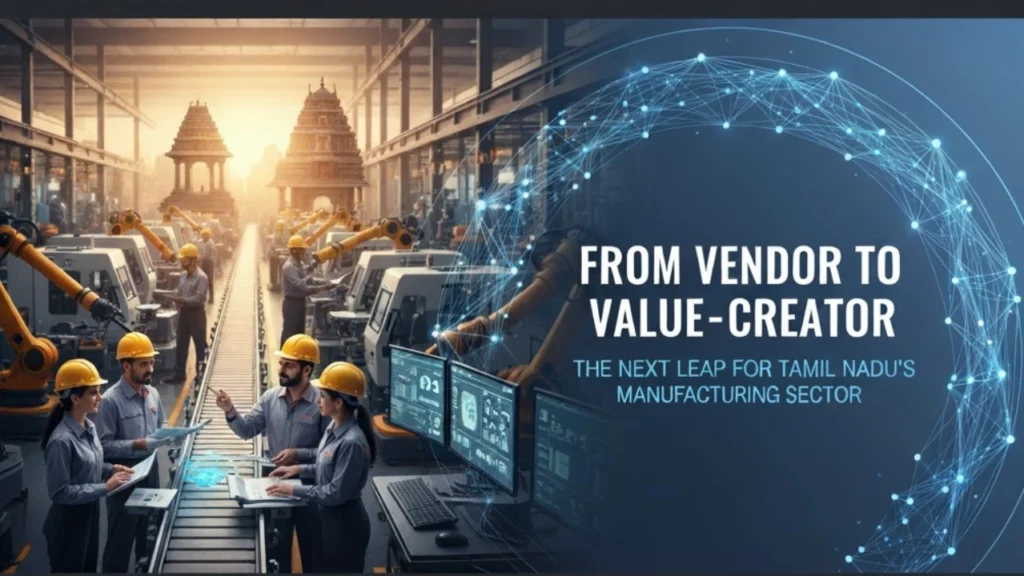
For decades, Tamil Nadu has stood as one of India’s most industrially advanced states—home to automotive giants, engineering majors, and export-oriented manufacturers. With a strong infrastructure base and skilled workforce, the state has built a legacy of manufacturing excellence. But in today’s era of global realignment, cost competition alone is no longer enough. The new growth narrative belongs to companies that evolve from being vendors to becoming value-creators—partners who innovate, design, and shape the future of manufacturing.
1. Tamil Nadu’s Manufacturing Landscape: Strong Foundation, New Challenges
Manufacturing contributes nearly 34% of Tamil Nadu’s Gross State Domestic Product (GSDP)—one of the highest among Indian states.

The state hosts over 39,500 registered factories as of 2022, according to CEIC data, spanning automotive, machinery, electrical, and textiles. Foreign investors have long recognized this strength—cumulative FDI inflows exceeded ₹3.8 lakh crore (US$45 billion) by December 2024, while merchandise exports touched ₹3.9 lakh crore (≈US$46.5 billion) in FY 2024-25.
These numbers highlight a powerful base—yet, many firms continue to operate as tier-2 or tier-3 vendors supplying standardized parts to larger OEMs. Margins remain thin, innovation is limited, and dependence on a handful of customers makes growth fragile. The opportunity now lies in moving up the value chain—into design, development, systems integration, and global supply participation.
2. The Vendor vs. Value-Creator Mindset
Traditionally, Tamil Nadu’s manufacturing success has been built on volume, cost efficiency, and reliable delivery. However, global buyers are now seeking partners who can contribute innovation, flexibility, and sustainability, not just manufacturing muscle.
- Vendors typically “make to print”—producing to client specifications at low margins.
- Value creators collaborate in co-development, design, R&D, and supply chain orchestration.
This mindset shift transforms how firms view their role: not merely executing an order, but influencing how a product is conceived, engineered, and delivered to market.
Global Tailwinds Favoring India—and Tamil Nadu
A global supply chain reset is underway. Multinationals diversifying from China are turning to India as part of their “China + 1” strategy, driving record investments. India’s electronics manufacturing approvals crossed US$625 million (₹55 billion) in late 2024, with Tamil Nadu attracting a major share in components and assembly units.
Meanwhile, India’s manufacturing Gross Value Added (GVA) grew by 11.9% in FY 2023-24, supported by a 5.9% increase in employment, according to the Ministry of Statistics. These macro indicators point to one message—the manufacturing window is wide open, but only agile firms ready to climb the value curve will truly capitalize.
Tamil Nadu’s Competitive Edge
The state is uniquely positioned for this transformation. It leads India in the number of factories and industrial employment, backed by a network of specialized clusters—from automotive in Oragadam and Hosur to electronics in Sriperumbudur and textiles in Coimbatore.
Its startup ecosystem, valued at over US$28 billion and growing ~23% annually, adds a fresh layer of innovation and collaboration potential. Tamil Nadu’s Vision $1 Trillion Economy roadmap clearly identifies manufacturing as the key pillar, supported by initiatives in EVs, aerospace, and advanced engineering.
Levers for Moving Up the Value Chain
To transition from vendor to value creator, manufacturing leaders should focus on five strategic levers:
- Design and Engineering Capabilities: Build or partner for in-house R&D and design functions. Moving from “make-to-print” to “design-to-market” is the most critical shift.
- Ecosystem Orchestration: Lead supplier ecosystems—coordinate smaller vendors, logistics, and quality frameworks—and become system integrators.
- Innovation & Product Differentiation: Develop connected, sustainable, or smart product features that appeal to global OEMs and new-age customers.
- Export & Market Diversification: Expand beyond domestic OEM contracts into global Tier-1 supply networks and aftermarket services.
- Digital & Smart Manufacturing: Adopt lean operations, Industry 4.0, data analytics, and traceability to build competitive, resilient supply chains.
Early Examples of Transition in Action
We’re already seeing promising signs across Tamil Nadu’s industrial belt.
- EV manufacturing: The state now accounts for nearly 40% of India’s EV production (≈400,000 units in 2023), creating demand for high-value systems like battery modules, BMS units, and power electronics. Component suppliers are now co-developing with OEMs—a key indicator of value creation.
- Electronics exports: Tamil Nadu’s electronics exports surged 78% year-on-year, from US$5.37 billion to US$9.56 billion between FY 2023 and 2024. Firms are shifting from assembling components to producing finished consumer and industrial devices for global markets.
These case shifts show that when firms invest in technology, engineering, and brand partnerships, the payoff is exponential in both revenue and resilience.
Challenges on the Road
This evolution, however, demands a new playbook. Skill gaps in product design, limited exposure to global markets, and a risk-averse mindset often hold back transformation. Investments in R&D or digital upgrades can appear costly in the short term. Moreover, customer relationships—built over decades on price and delivery—must now evolve toward innovation and collaboration.
Bridging this transition requires structured change management and capability development, not just capital investment.
Conclusion: The New Definition of Growth
Tamil Nadu’s next wave of industrial growth will be defined not by cost efficiency, but by value creation. Firms that invest in design, innovation, and ecosystem leadership will capture a far greater share of global opportunity.
As one of India’s most advanced manufacturing states, Tamil Nadu is perfectly placed to lead this transformation, provided its enterprises reimagine themselves not as vendors, but as strategic architects of value.
The question for every manufacturing leader today is simple: Are we still making parts, or are we building the future?
Let’s connect to explore how we can help your organization move from vendor to value creator—building innovation, resilience, and sustainable growth in Tamil Nadu’s manufacturing landscape.