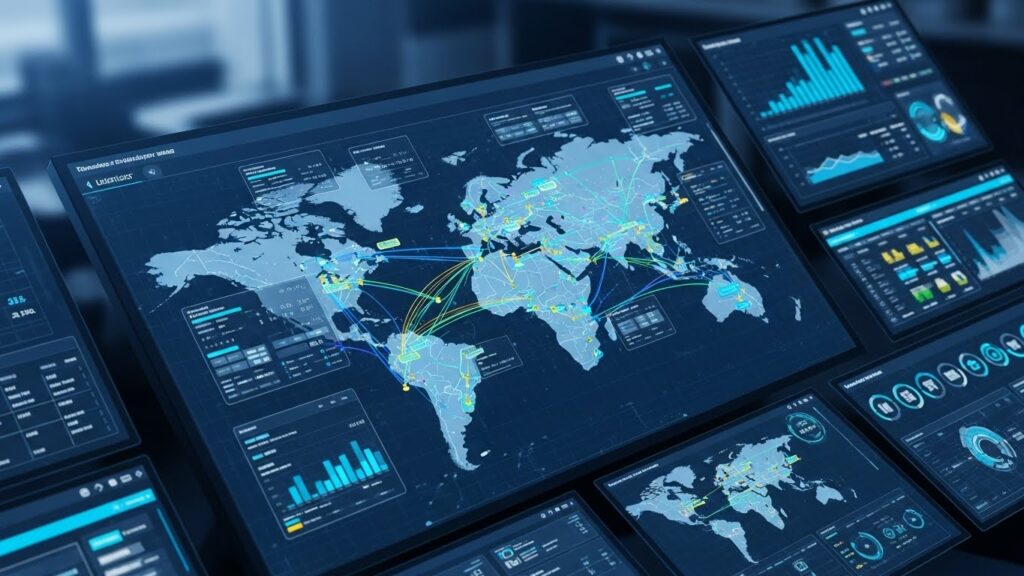
The modern supply chain control tower system has evolved from dashboard-based systems to perform exception management and predictive risk assessment and cross-functional execution of planning and procurement and manufacturing and logistics operations.
The problem control towers were meant to solve
Most supply chains fail because teams put in sufficient work rather than because of insufficient team effort. The system fails because decisions get made using incomplete data which exists across separate systems that operate at different times. Customer service sees a missed delivery when the customer complains. The logistics team detects when a carrier fails to retrieve their shipment after the scheduled pickup time has ended. The planning team identifies inventory mistakes which occur when products get placed in wrong storage locations. The production line faces delays because procurement staff find out that their suppliers face delivery delays.
Organizations maintain visibility through different systems which include tracking portals and planning reports and individual spreadsheet management of expediting rules and numerous unstructured emails containing essential information. The final result becomes firefighting which involves reactive expedited work and creates unstable customer commitments and requires urgent product modifications and leads to rising delivery expenses.
A supply chain control tower was created to fix that. People widely believe that a control tower functions as a dashboard system. Dashboards are useful, but they are not the objective. The organization needs to achieve speedier decisions which produce superior results through synchronized execution between different departments and their external partners.
A real control tower functions as the central command point which monitors current events and predicts upcoming situations and provides guidance about necessary actions and assigns tasks to specific personnel for execution and tracks results to enable organizational learning and enhancement.
What do you mean by a control tower?
A modern supply chain control tower is a capability—not just a tool—that provides:
- The system provides complete situational awareness through its single operational dashboard which shows demand and supply data alongside inventory levels and logistics information.
- Exception management: automated identification and prioritization of issues that matter.
- The system provides decision support through its presentation of service options together with their corresponding costs and financial implications and risk levels.
- The orchestration process enables users to track workflow progress through workflow management which allows them to execute actions until the process reaches its final stage.
A control tower that only uses screens for operations will create awareness, but it will not produce any actual results. The system functions as an execution engine when it includes orchestration features.
The evolution: from visibility to orchestration
Control towers have developed through four established stages of development. Your present life situation will help you decide which investment options to choose.
Stage 1: Tracking and reporting.
- The system enables users to track their shipments through KPI dashboards which show scheduled shipment information.
- The organization needs to establish two fundamental core values which consist of transparent business operations and enhanced financial reporting standards.
- Limitation: you still react late.
Stage 2: Exception detection
- Organizations use rules to identify when delays or shortages or misses take place.
- The system allows users to identify system problems at the time they occur.
- Limitation: The system produces too many alerts which create difficulties for users to identify critical alerts that need urgent response.
Stage 3: Prioritized exception management
- The system handles exceptions through operational impact assessments which follow predetermined response protocols.
- The system provides two main advantages which include reduced fire occurrences and improved decision-making stability.
- Limitation: The system lacks functionality to remove stored actions which stay present in email messages together with conference discussion records.
Stage 4: Orchestrated execution
- The system transforms decisions into work assignments which require specific owners to handle them while following established Service Level Agreements (SLAs) and approval processes and system maintenance procedures.
- Value: The system delivers operational value through quantifiable performance enhancements which users maintain their usage of the system.
Stage 2 and Stage 4 exist as separate categories because Stage 2 indicates knowledge of information, but Stage 4 indicates full mastery of the situation.
Expected business outcomes a control tower should deliver
A control tower program needs to produce results which can be quantified. Most common parameter where we can see impact of control towers:
- Service reliability: The system delivers improved service reliability through its ability to achieve higher OTIF rates and its reduction of both promise-date failures and customer escalation cases that result from expedite requests.
- Cost control: The company achieved cost control through its implementation of premium freight reduction and its selection of optimal carriers and transportation modes and its enhanced consolidation process and its ability to minimize late changes.
- Inventory efficiency: The system achieves three main benefits through its improved inventory management capabilities. The system optimizes inventory distribution when supply limitations exist while it minimizes inventory mistakes that involve placing wrong items in wrong locations. The system enables organizations to maximize their buffer stock usage.
- Resilience: The system allows for prompt identification of supplier and logistics threats which results in faster response times when disruptions occur.
- Productivity: The system boosts productivity because it removes the need for human status verification and reduces the number of meetings required for data verification which allows staff members to dedicate their time to their essential problem-solving work.
The lack of established performance targets will convert control towers into unnecessary systems which people find interesting.
Five fundamental building blocks of a modern control tower
A functional control tower requires five fundamental elements which create its operational framework. You can build them iteratively.
1) A unified operational model
The base of this system requires master data and event data to match each other for all organizations to share one common understanding of reality. Typical entities include:
- The system contains SKUs and orders together with customers and lanes and locations and suppliers and plants and DCs.
- The system tracks all essential business data through its order status function which also displays inventory levels and production progress and transportation progress.
- Constraints: lead times together with MOQs and capacity limitations and product shelf-life and temperature storage needs.
A control tower operates independently from your existing ERP system and WMS system and TMS system and planning system. The operational narrative combines all these components to create a single operational story which unites them.
2) Exception logic
A plan needs to exist for exceptions to occur because these situations represent any deviation from what was originally expected. Examples:
- The system generates more inbound material confirmation slips than the established maximum threshold.
- The production order schedule fails to reach its predetermined target levels.
- The logistics team did not succeed in delivering their shipments according to their established time schedule.
- The inventory levels for a vital SKU have dropped to a level which is lower than the established safety stock amount.
- Demand exceeds the predicted levels which are shown in the forecast bands.
Good exception logic includes context:
- Customer tier and margin impact
- SKU criticality and substitution options
- Regulatory or temperature constraints
- Recovery options and costs
“An exception engine operating without proper context will produce only random system noises.”
3) Prioritization
The process of value acceleration takes place during the prioritization stage. The tower system implements an exception ranking system which determines the severity of each problem.
- Revenue at risk (and when the risk materializes)
- Penalties or contractual exposure
- Customer tier (strategic vs transactional)
- Expediting cost to recover
- Downstream ripple effects (e.g., one part blocks multiple SKUs)
“A control tower of high quality enables teams to handle their most critical 10 problems which are essential rather than their extensive list of 200 system alerts.”
4) Playbooks
Organizations use playbooks to convert their decision-making process from unstructured discussions into structured operational procedures. A playbook defines:
- Trigger and severity levels
- Options (reroute, expedite, reallocate, substitute, reschedule)
- Approval levels (who can authorize cost increases)
- The system needs to perform all operations according to the Service Level Agreement (SLA) which has been defined.
- Communication templates to customers and partners
“Playbooks function to create uniform human decision-making protocols which do not eliminate human involvement in the process.”
5) Orchestration workflows
The main factor which sets this solution apart from others is orchestration. It includes:
- The system allows users to distribute work assignments to owners while users can establish deadlines for task completion.
- Approval paths based on cost thresholds
- The system updates source systems by making changes to promise dates and shipping bookings and inventory availability and production planning schedules.
- Closed-loop tracking: did we solve it? at what cost? did it recur?
Operating model for control tower
The best technology systems need an operating model to function properly. The control tower needs to define exact duties which staff members will execute for their tasks.
A practical operating model includes:
- The Tower lead / operations manager maintains daily operations through their responsibility to establish daily work schedules and determine important tasks and verify that all tasks receive proper completion.
- The organization has established functional owners who maintain planning and procurement and logistics and customer service and manufacturing responsibilities with specific decision authority.
- The analysts together with data stewards maintain data quality and perform exception tuning and monitor KPI accuracy.
- The system contains escalation governance which defines particular thresholds that need approval for premium freight services and promise-date modifications.
- The system requires suppliers and carriers to establish specific rules for their partnership through which they need to share their data.
Many control towers underperform because they are launched as an IT project rather than an operational capability.
Architecture
A control tower architecture doesn’t need to be complicated, but it must be intentional.
Data layer:
- Integration: The system includes multiple integration capabilities which connect to ERP and planning systems and WMS and TMS and MES and supplier portals and carrier tracking systems.
- Data Model: The system contains five core data models which include orders and items and milestones and inventory positions and capacities.
- Governance: master data consistency, event timestamp accuracy
Analytics layer:
- KPI computation and alert rules
- The system proved useful for predicting three specific elements which included late risk and lead-time variability and demand anomalies.
- Scenario evaluation (cost vs service vs timing)
Action layer:
- Workflows/ticketing with SLAs
- Approvals and audit trails
- The system updates all necessary information which gets stored in transactional systems.
What you typically don’t need at the start:
- Perfect real-time data everywhere
- All decision-making operations need sophisticated AI systems to function correctly.
- The entire supply chain needs to have full partner integration which includes all suppliers and carriers.
“Start by creating the fundamental flow paths which will serve as the base for your system before you introduce additional system elements.”
Implementation roadmap:
A control tower operates at its best through a process of staged implementation. A common roadmap:
Phase 1: MVP (8–12 weeks)
- Pick 2–3 use cases
- The system requires only essential operational systems for operation.
- The system requires exception handling systems together with priority rules for its operational functionality.
- Create basic workflows
- Establish daily cadence
Phase 2: Scale (3–6 months)
- The project needs to add new lanes and plants and distribution centers and expand its product range.
- Improve data quality and master data alignment
- The system needs new playbooks together with improved methods which will help identify original causes of system failures.
- The system requires better functionality to display partner information throughout essential sections of the system.
Phase 3: Orchestration And Automation (6–12 months)
- The system needs to establish deeper connections between its operational actions.
- Introduce scenario-based recommendations.
- The deployment of predictive risk models should take place when they generate valuable outcomes.
- Implement continuous improvement loops.
“The system needs people to start using it before we can proceed with adding complexity to the system.”
Common reasons for “why control towers fail”
Failure mode 1: “We built dashboards; no one uses them.”
The solution requires the team to link their tower work activities to their regular operational tasks instead of using it for monthly performance tracking.
Failure mode 2: “Too many alerts.”
The solution requires two steps which involve selecting the most critical issues based on their impact and then selecting only the essential ones.
Failure mode 3: “No decision rights.”
Fix: document who can do what—especially when costs increase.
Failure mode 4: “Data quality issues kill trust.”
The solution needs to start data stewardship operations right away while activating vital reconciliation systems.
Failure mode 5: “It’s an IT project, not an operations capability.”
The solution requires operation of this program as an operations program which needs defined ownership and scheduled execution.
Peak into the future
As supply chains become more volatile, control towers are becoming less like “monitoring centers” and more like adaptive execution engines. The best ones will:
- The organization needs to analyze previous system disruptions to determine which recovery methods produced successful results.
- recognize patterns (supplier slippage, lane variability)
- Recommend solutions which demonstrate their benefits together with their possible disadvantages.
- Coordinate with stakeholders who belong to both internal and external.
“The core principles of the system continue to function with the same principles which include unified truth and meaningful exceptions and impact-based prioritization and workflows that create a complete cycle.”
Next Steps
Your organization needs to answer four fundamental questions to create a control tower which produces significant results.
- The current situation requires organizations to focus on two essential outcomes between service delivery and cost management and cash flow maintenance and operational resilience.
- Which 2–3 use cases deliver those outcomes at the fastest speed?
- What decisions are currently slow, inconsistent, or siloed?
- How will actions be executed and tracked (not just visualized)?
The control tower should be built based on your established answers because this approach will create a daily competitive advantage which extends beyond displaying a screen.